Hello, we are SEFORAA.

Contact us to ask about the applications, request a quotation, or schedule a demo. Our team is ready to help during business hours.

Schedule a demo

Follow us

SEFORAA ESG & Carbon: carbon accounting software and bilingual Sustainability Reports

Prepare audit-ready, bilingual Sustainability Reports that meet OJK requirements, with an application installed on your own company's server. Calculate Scope 1, 2 and 3 emissions, prepare SEOJK 16 and PSPK 2 disclosures, and trace every figure back to its source document.

Getting ready for PSPK 1 and PSPK 2

From facility data to a Sustainability Report, in one application

Sustainability Reports are required by POJK 51/POJK.03/2017 for financial services institutions, issuers and public companies; for issuers and public companies, their content is governed by SEOJK 16/SEOJK.04/2021. PSPK 1 and PSPK 2 from IAI apply to reporting periods beginning on or after 1 January 2027. Both demand emission figures that can be explained: where the data came from, which emission factor was used, and who approved it.

SEFORAA ESG & Carbon brings together activity data collection, layered approval, emission calculation, ESG disclosures and Sustainability Report preparation, so the sustainability team, finance, the Board of Directors and auditors all see the same figures.

  • Scope 1, 2 and 15 Scope 3 category calculations from versioned emission factors
  • A trail for every figure back to the factor, source document and approval
  • SEOJK 16 and PSPK 2 item catalog in Indonesian and English
  • Bilingual Sustainability Report with an automatic G.4 index
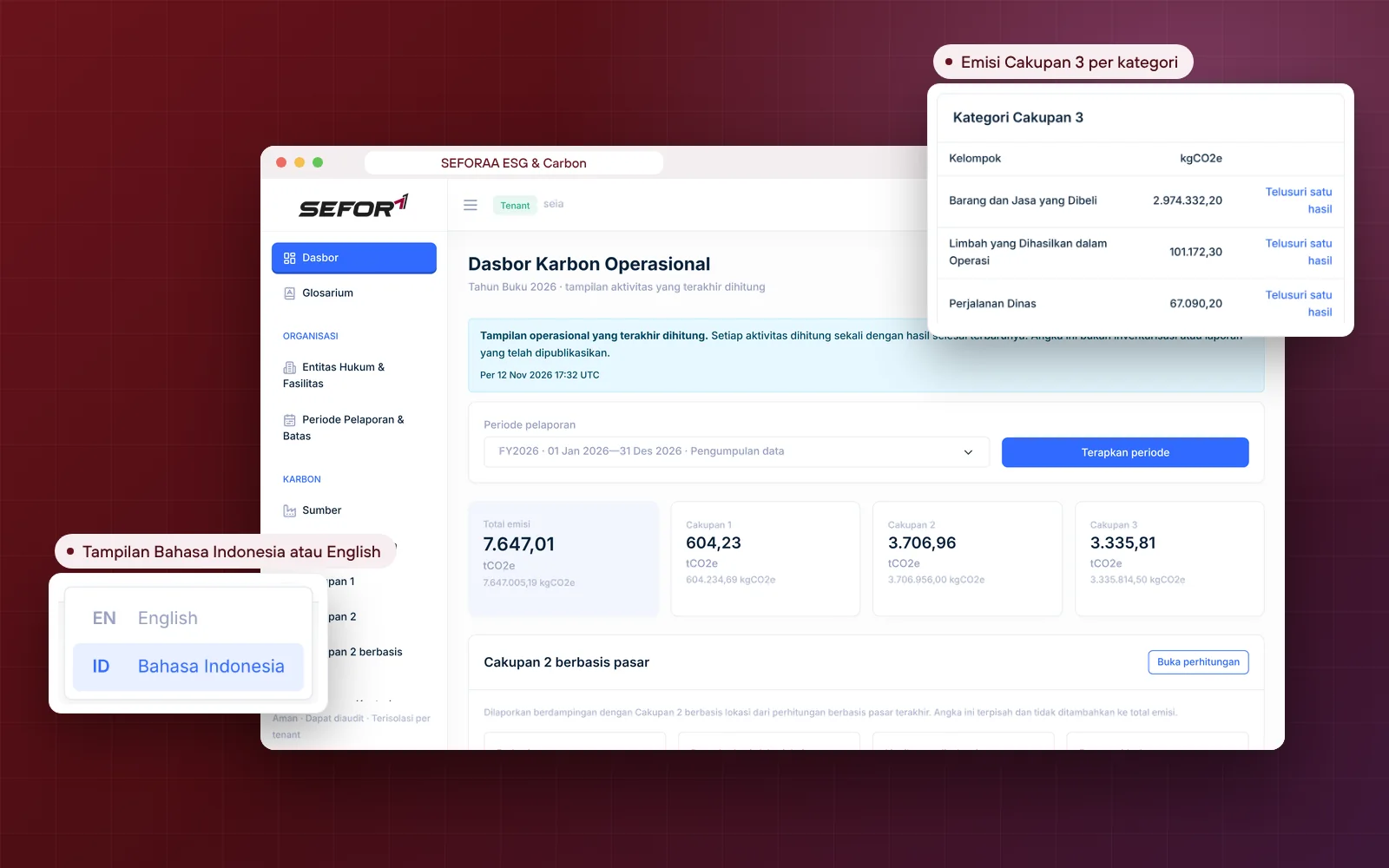
SEFORAA ESG & Carbon carbon dashboard in Indonesian: total emissions, Scope 1, 2 and 3, Scope 3 emissions per category, and interface language choice

Why SEFORAA ESG & Carbon

An audit-ready, bilingual Sustainability Report that meets OJK requirements, and stays on your server

Three things you can check for yourself in the demo: 50 SEOJK 16 items and 16 PSPK 2 items are mapped one by one, every emission figure can be traced to its source document, and the application and its data stay on the company's server.

New · ready for the 2027 reporting period

Collect 2027 period data correctly from day one

PSPK 1 and PSPK 2 apply to annual reporting periods beginning on or after 1 January 2027. For companies that apply them, data throughout 2027 becomes the basis for the first disclosure. The following capabilities prepare SEFORAA ESG & Carbon for that period.

SEFORAA ESG & Carbon features

From facility data to the Sustainability Report

Filter by group to see the features most relevant to your team.

  • Entities and facilities

    Legal entity hierarchy with ownership percentage and control status, plus facilities per location.

    Structure & periods
  • Organizational boundary per period

    Organizational boundary snapshot using the equity share, financial control or operational control approach.

    Structure & periods
  • Reporting period cycle

    From data collection, reviewed, approved, locked, through to reported, and can be reopened with a recorded trail.

    Structure & periods
  • Emission source register

    Every emission source is recorded with its scope, category, facility, PIC, unit and factor mapping.

    Activity data
  • Campaigns and assignments

    Collection windows and deadlines per period, assignment of emission sources to PICs, plus deadline reminders.

    Activity data
  • Forms and Excel templates

    Activity data is entered through forms or Excel templates per assignment, with preview and validation of every row.

    Activity data
  • Maker-checker flow

    Draft, submission, reviewer check and final approval by different people, including corrections to approved data.

    Activity data
  • Validation and reasonableness checks

    Technical validation before submission, and a warning if data changes by more than 30% compared with the previous month.

    Activity data
  • Official emission factor library

    Official electricity and fuel factors from the Ministry of Energy and Mineral Resources (ESDM), IPCC 2006 CH4 and N2O, and IPCC AR6 GWP, versioned and approved before use.

    Emission calculation
  • Scope 1, 2 and 3 calculation

    Scope 1 stationary, mobile, fugitive and process; Scope 2 location-based and market-based; plus 15 Scope 3 categories.

    Emission calculation
  • Energy in gigajoules

    Electricity is converted from kWh to GJ, fuel through density from supplier certificates and official calorific values, for energy use and intensity.

    Emission calculation
  • GHG dashboard and inventory

    Totals per scope, facility, emission source, monthly trend, Scope 3 category and calculation completeness.

    Emission calculation
  • A trail for every result

    Emission results are linked to activity, factor version, source document, formula, evidence and approval history.

    Emission calculation
  • Data quality grades

    Reviewers grade data from A, verified primary data, to E, proxy, and the grading is recorded with versions.

    Activity data
  • Governance and strategy

    Records of board oversight, committees, policies, meetings, climate strategy, transition plans and scenario assumptions.

    Disclosure & reports
  • Risks, metrics and targets

    Physical risks, transition risks and opportunities; ESG metrics per period; targets with baselines and initiatives.

    Disclosure & reports
  • SEOJK 16 and PSPK 2 disclosures

    Disclosure items with Indonesian and English narratives, approval flow, evidence links and completeness indicators.

    Disclosure & reports
  • Bilingual Sustainability Report

    PDF and Excel with three-year comparison, emission intensity, ESG metrics and an automatic G.4 index.

    Disclosure & reports
  • Supporting reports

    Carbon inventory reports, ESG data books and PSPK working papers, prepared from configurable templates.

    Disclosure & reports
  • Versions, approval and publication

    Report versions with a SHA-256 fingerprint, internal approval, publication, assurance and submission records, plus sharing links with recorded PDF downloads.

    Disclosure & reports
  • Roles, MFA and audit log

    Custom roles from a permission catalog, configurable approval flows, delegation, MFA and audit log.

    Control & integration
  • Bilingual and Glossary

    Indonesian and English display chosen per user, plus a Glossary menu of ESG and carbon terms.

    Control & integration
  • REST API and webhooks

    Data from ERP, procurement systems or IoT sensors comes in through the API, and webhooks notify other systems when a report is published.

    Control & integration

Need a feature that is not listed?

Discuss your needs

Emission calculation coverage

Scope 1, Scope 2 with two methods, and all 15 Scope 3 categories

The classification follows the GHG Protocol, which PSPK 2 also references. Scope 1 covers stationary combustion, mobile combustion, fugitive emissions and process emissions. Scope 2 for purchased electricity, steam, heating and cooling is calculated with the location-based and market-based methods.

For electricity and fuel, factors are taken from the official library included: electricity grid emission factors from Minister of Energy and Mineral Resources Decree, CO2 factors and fuel calorific values from the Ministry of Energy and Mineral Resources, CH4 and N2O factors from the IPCC 2006 Guidelines, and GWP values from IPCC AR6. CO2, CH4 and N2O are calculated separately for each fuel, then summed into CO2e. Scope 3 factors are added by the company itself from sources it chooses, for example supplier data. Every factor is still approved before use.

Energy consumption is also expressed in gigajoules (GJ). Electricity is converted directly from kWh. Fuel in liters is converted to kilograms using the density from the supplier's quality certificate, approved by another team member, then to GJ using the calorific value from the Ministry of Energy and Mineral Resources. That way, energy use and intensity are ready to disclose.

Upstream Scope 3

  1. 1. Purchased goods and services
  2. 2. Capital goods
  3. 3. Fuel- and energy-related activities
  4. 4. Upstream transportation and distribution
  5. 5. Waste generated in operations
  6. 6. Business travel
  7. 7. Employee commuting
  8. 8. Upstream leased assets

Downstream Scope 3

  1. 9. Downstream transportation and distribution
  2. 10. Processing of sold products
  3. 11. Use of sold products
  4. 12. End-of-life treatment of sold products
  5. 13. Downstream leased assets
  6. 14. Franchises
  7. 15. Investments

Closer look

From facility data to the published report.

Activity data and approval

Data from every facility is collected on time and checked before it is calculated

Set who fills in data for each emission source and when it is due. The PIC fills it in through a form or Excel template, attaches evidence such as an electricity bill or fuel invoice, then submits it. The reviewer checks it, and an approver different from the person who entered it gives final approval.

  1. Collection campaigns with deadlines per period
  2. Assignment of emission sources to facility PICs, with reminders
  3. Excel template per assignment: preview, per-row validation, then save as draft
  4. Evidence documents with SHA-256 checksum
  5. Technical validation and monthly reasonableness checks
  6. Review queue, approval queue and corrections to approved data
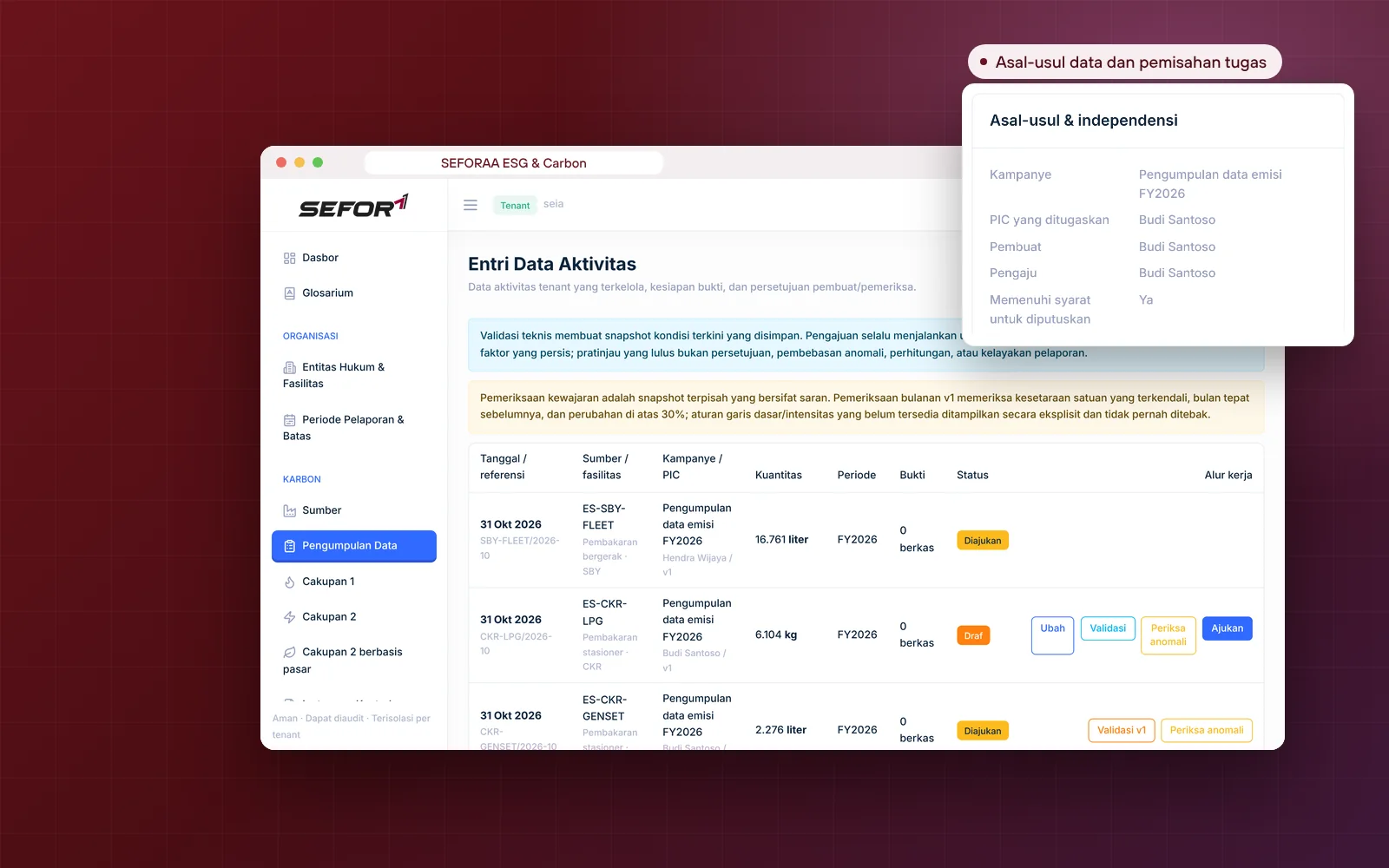
Activity data entry list in SEFORAA ESG & Carbon with submitted and draft status, validation and anomaly check buttons, plus data provenance and separation of duties

Emission calculation and audit trail

Every emission figure can be traced to its source document

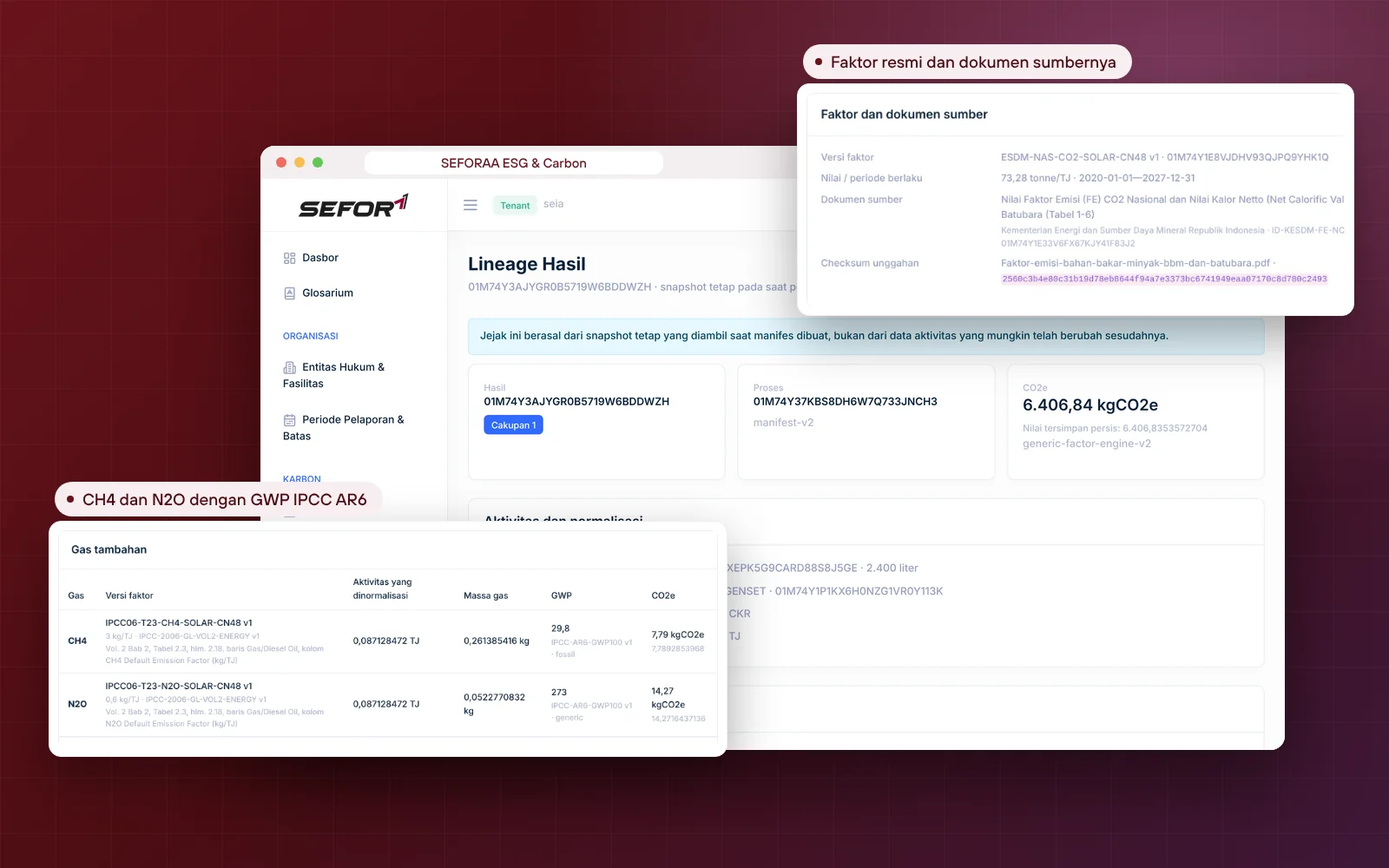
The calculation uses the emission factor version in effect for each activity, then freezes its state at calculation time. If an auditor asks where the figure 6,406.84 kgCO2e for the December generator came from, the answer is on one page: liters of diesel, density, calorific value, CO2, CH4 and N2O factors, through to who approved the data.

  1. Versioned official factor library: Ministry of Energy and Mineral Resources (ESDM), IPCC 2006 and IPCC AR6 GWP, with page and table references
  2. Snapshot of data, evidence and approval at calculation time
  3. Formula, method and GWP values recorded for every result
  4. Breakdown per gas (CO2, CH4, N2O) and the energy path in GJ
  5. Results per scope, facility, emission source and Scope 3 category
  6. Data quality grades A to E
  7. The result trail does not change even if activity data is corrected later
Lineage page of a generator emission result in SEFORAA ESG & Carbon: result 6,406.84 kgCO2e, official Ministry of Energy and Mineral Resources factors with their source documents, plus CH4 and N2O with IPCC AR6 GWP

Entities, facilities and reporting boundary

A clear organizational boundary for every reporting period

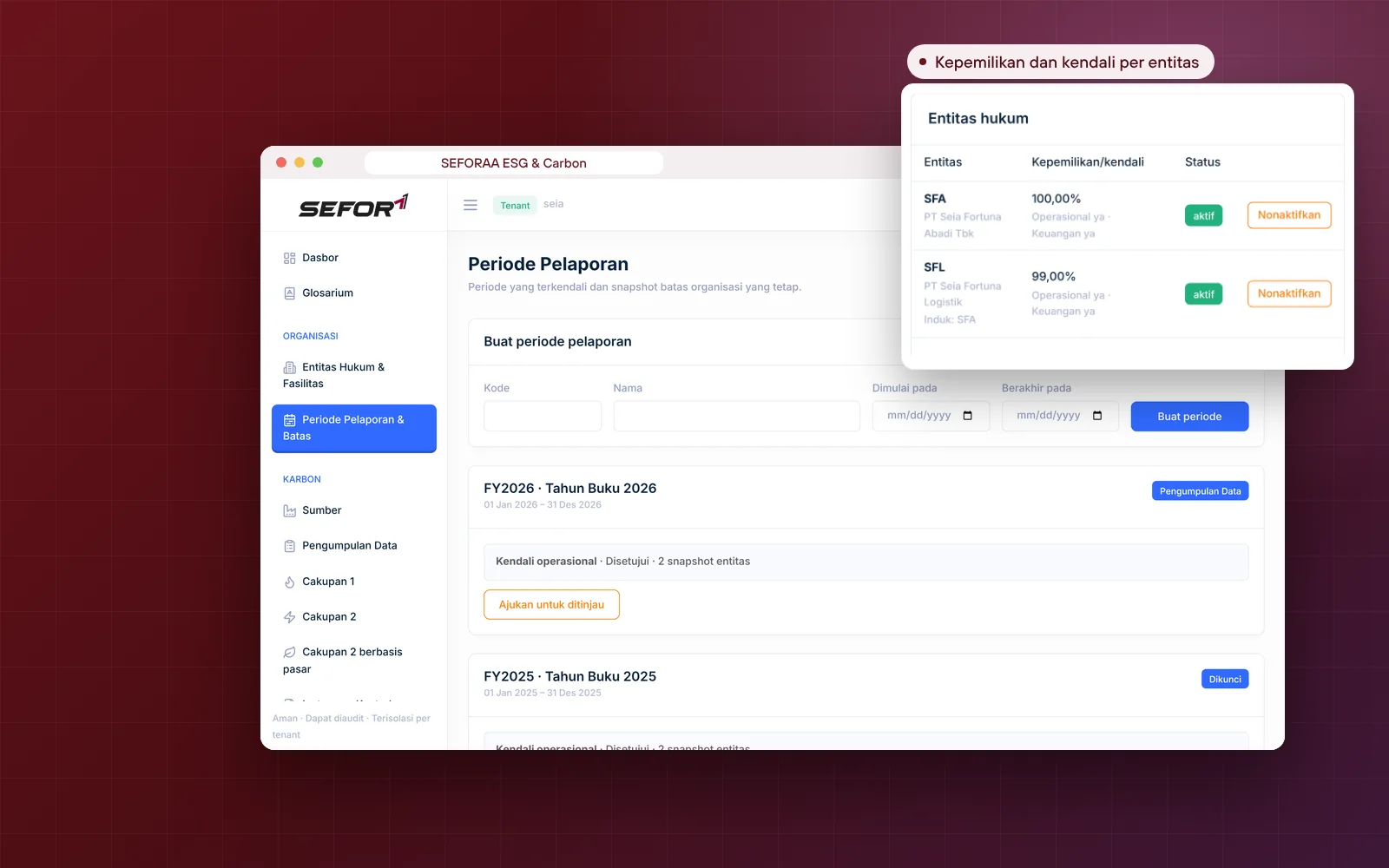
Build the legal entity hierarchy with ownership percentage and control status, then set the organizational boundary approach for each period. The boundary snapshot is saved per period, so prior-period figures do not change when the group structure changes.

  1. Parent and subsidiary hierarchy
  2. Ownership percentage, operational control and financial control
  3. Facilities per entity with location and time zone
  4. Equity share, financial control or operational control approach
  5. Periods are submitted, approved, locked, then marked as reported
  6. Periods can be reopened with a recorded reason
Reporting period and organizational boundary in SEFORAA ESG & Carbon, with ownership and control per legal entity

Governance, strategy, risks and targets

Climate disclosure material prepared in the same place as the emission figures

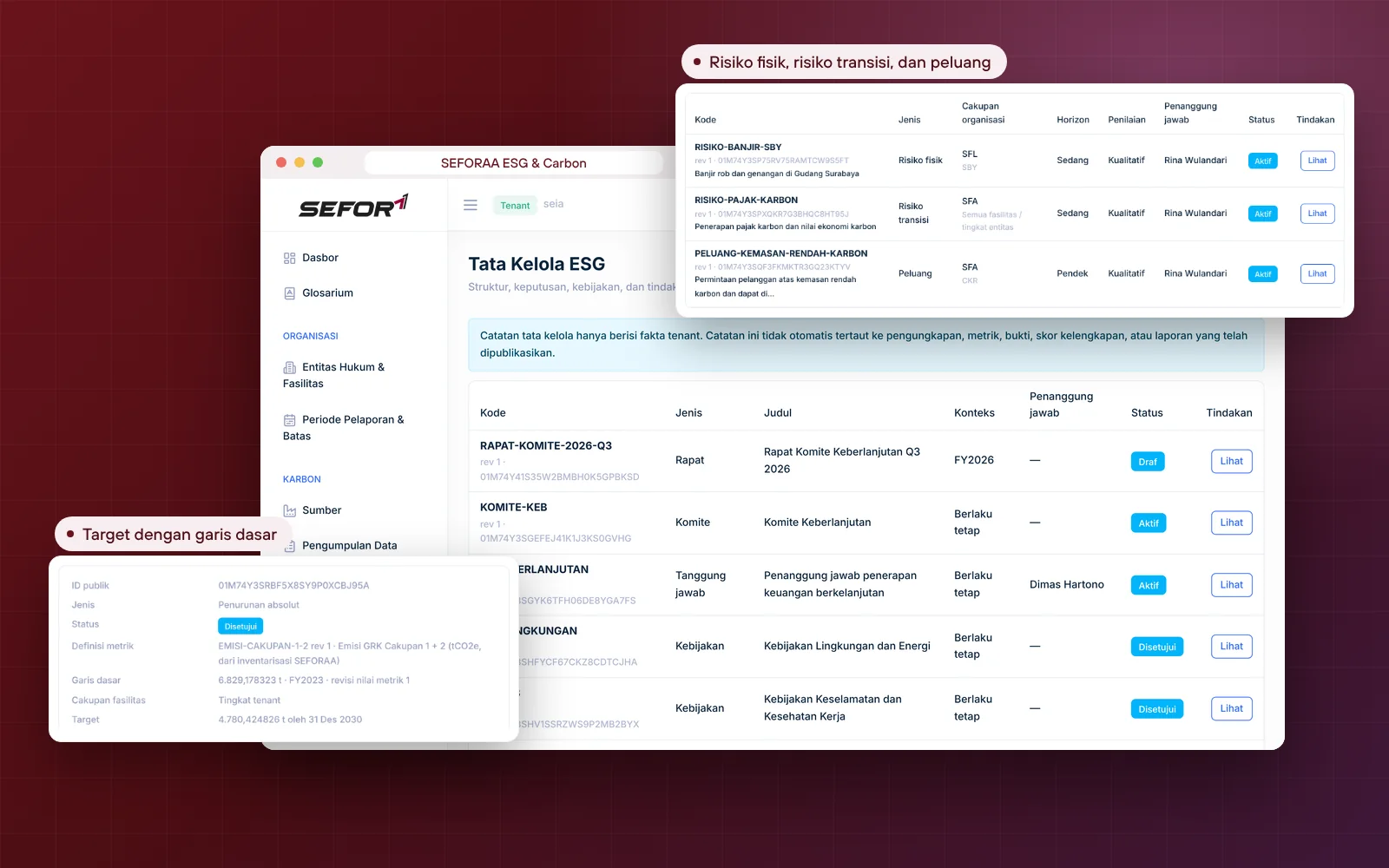
PSPK 2 structures climate disclosure in four areas: governance, strategy, risk management, and metrics and targets. SEFORAA ESG & Carbon provides versioned registers to record the material, so disclosure narratives are prepared from documented records.

  1. Board oversight, committees, responsible parties, policies and meetings
  2. Climate strategy, transition plans and scenario assumptions
  3. Physical risks, transition risks and opportunities with time horizons
  4. ESG metrics and their values per period and facility
  5. Targets with baselines, deadlines and supporting initiatives
  6. Evidence documents linked to related records
ESG governance register, register of physical risks, transition risks and opportunities, plus emission reduction targets with baselines in SEFORAA ESG & Carbon

SEOJK 16 and PSPK 2 disclosures

Every disclosure item is written in Indonesian and English

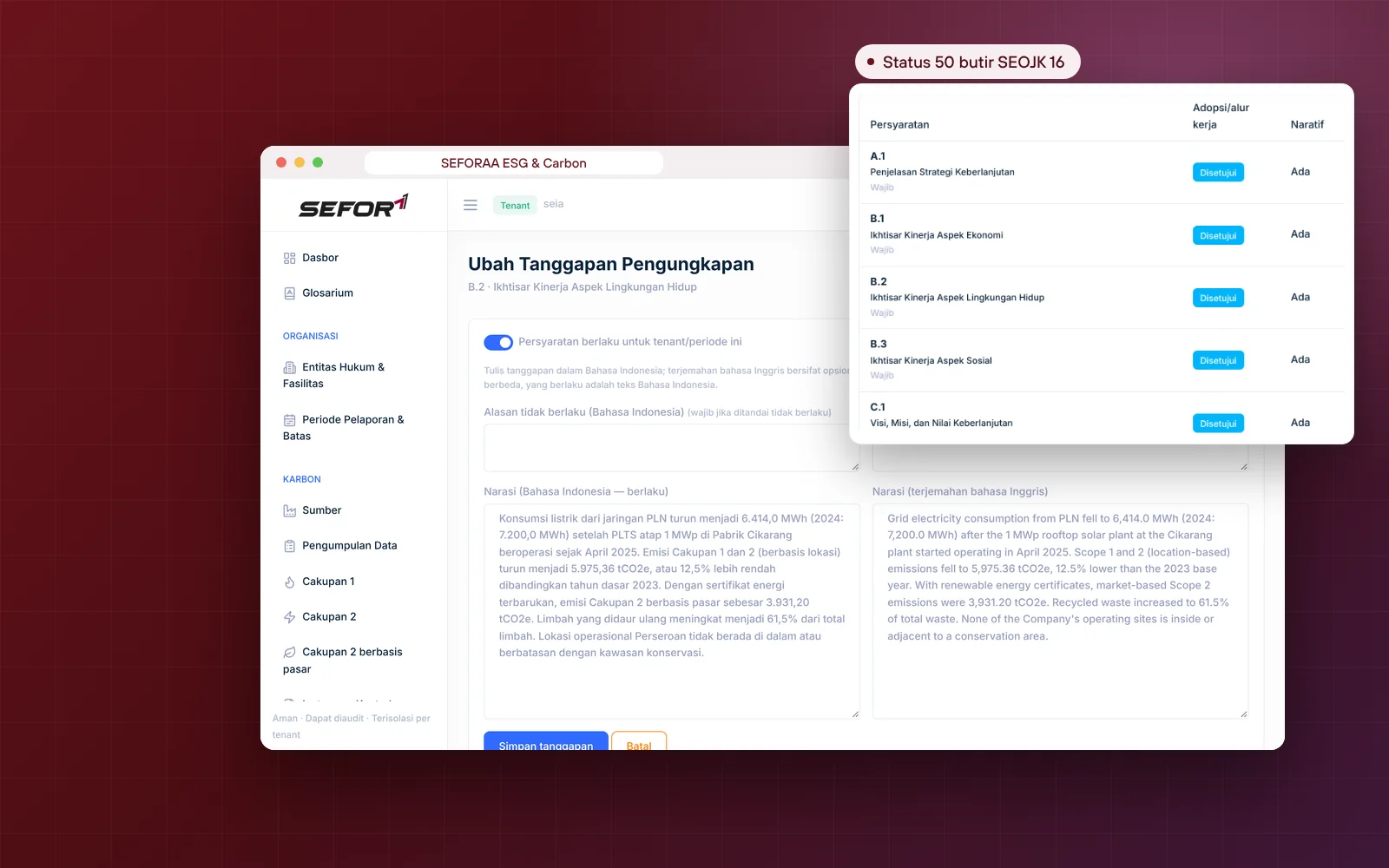
The catalog of SEOJK 16 Appendix II items and PSPK 2 is already prepared, each with an Indonesian and English title. For each period, your team fills in the Indonesian narrative as the governing text and the English translation beside it, or marks items that do not apply along with the reason.

  1. 50 SEOJK 16 items and 16 PSPK 2 items
  2. Indonesian narrative and English translation side by side
  3. Reason for not applicable in two languages
  4. Flow: draft, data ready, reviewed and approved
  5. Completeness indicator per catalog and period
  6. Versioned catalog: new versions are added without changing reports already published
SEOJK 16 item B.2 disclosure response form with Indonesian narrative and English translation side by side, plus the approval status of disclosure items in SEFORAA ESG & Carbon

Sustainability Report

Bilingual Sustainability Report, built from approved data

Choose a template, period and disclosure catalog, then the application prepares the Sustainability Report: emission and energy performance compared up to three years, ESG metrics, narrative for every item in Indonesian and English, and the G.4 disclosure index. Items that are not yet approved are marked as drafts and are never listed as already disclosed.

Once approved, the report is published as a fixed version with a SHA-256 fingerprint. Submission to the regulator and assurance results can be recorded on the published report, so its history is complete.

  1. Structure of items A to G of Appendix II of SEOJK 16
  2. Two-column PDF: Indonesian on the left, English on the right
  3. Language clause and calculation methodology notes
  4. PSPK 2 climate disclosure section for periods from 2027
  5. Export of disclosure, emission and metric tables to Excel
  6. Fixed version, internal approval (for example by the Board of Directors), publication and sharing link
  7. Link recipients can download the published PDF, and every download is recorded in the audit log
  8. Energy use and intensity in gigajoules (GJ)
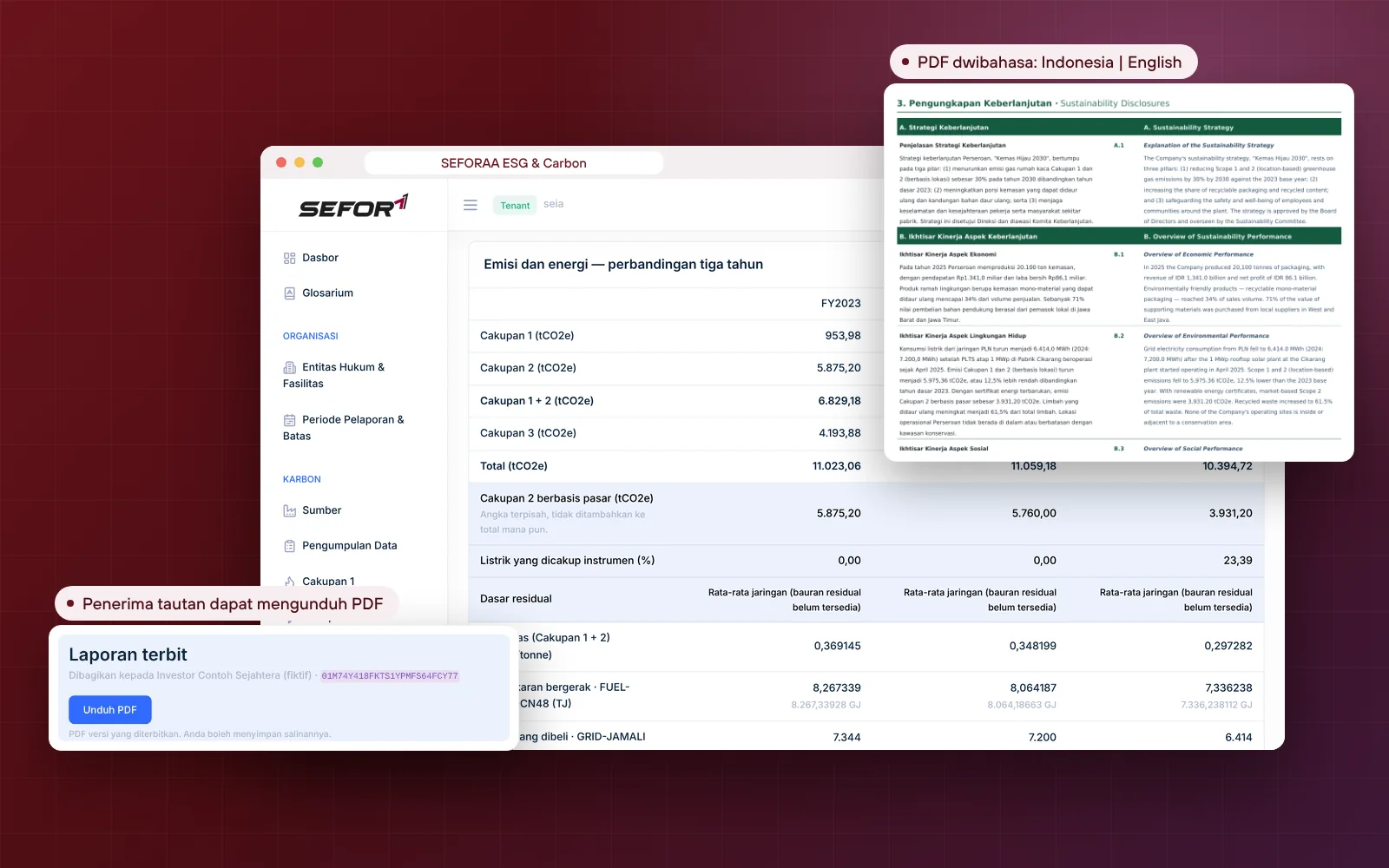
FY2025 Sustainability Report in SEFORAA ESG & Carbon: three-year emission and energy comparison including market-based Scope 2, bilingual Indonesian and English PDF, and a Download PDF button for link recipients

Integration

Activity data does not need to be retyped

Data from other systems comes in as drafts, then goes through the same validation, review and approval as manual input. Emission figures are still calculated by the application from approved emission factors.

  • Connected to SEFORAA Accounting

    Transactions recorded on special accounts or journals in SEFORAA Accounting are forwarded as draft activity data, so the finance team does not need to resend the data.

    1. Fuel purchases for vehicles and generators
    2. Electricity bills per facility
    3. Train and flight tickets for business travel
    4. Reference to the originating journal on every activity record

    Applies with special terms, including preparing the chart of accounts and journals that record quantities, such as liters of fuel, kWh of electricity or travel routes.

  • REST API, webhooks, ERP and IoT

    Send activity data from an ERP, procurement system, or IoT meters and sensors through the REST API. Incoming data has draft status and is validated like manual input.

    1. Authorized, time-limited and revocable API tokens
    2. The same validation and approval as manual input
    3. HMAC-signed webhooks when data is approved, calculation is complete or a report is published
    4. API documentation included

    Integration with specific systems can be developed by our team.

Capability matrix

SEFORAA ESG & Carbon capability details

A checklist for sustainability, finance, IT and procurement teams evaluating ESG and carbon accounting software. Choose a group or search for a capability to see its details.

Disclosure and Sustainability Reports 11 capabilities

SEOJK 16
50 Appendix II items (A to G) with Indonesian and English titles
PSPK 2
16 items in four areas: governance, strategy, risk management, and metrics and targets
IFRS S2 and TCFD
Referenced through PSPK 2 items, which IAI adopted from IFRS S2; its four areas follow the TCFD structure
GHG Protocol
Scope and Scope 3 category classification follow the GHG Protocol
ESG register
Governance, strategy and transition plans, scenario assumptions, climate risks and opportunities, ESG metrics, targets with baselines, and initiatives
Bilingual narrative
Indonesian narrative and English translation side by side, including the reason an item does not apply
Completeness
Completeness indicator per catalog and period
Sustainability Report
Bilingual PDF with language clause, three-year comparison, emission intensity, methodology notes and the PSPK 2 climate section
Automatic index
SEOJK 16 G.4 disclosure index
Output formats
PDF and Excel
Supporting reports
Carbon inventory reports, ESG data books and PSPK working papers from configurable templates

Carbon accounting 14 capabilities

Scope 1
Stationary combustion, mobile combustion, fugitive emissions and process emissions
Scope 2
Purchased electricity, steam, heating and cooling; location-based and market-based methods with contractual instruments: energy attribute certificates (for example REC), PPA, green tariff and supplier-specific factors
Scope 3
15 GHG Protocol categories, upstream and downstream
Emission factor library
Kepmen ESDM electricity grid factors, ESDM fuel CO2 factors and calorific values, IPCC 2006 CH4 and N2O factors, and IPCC AR6 GWP; ESDM source documents included; Scope 3 factors added by the company
Factor versions
Value, unit, validity period, region and source document; approved before use; history is never deleted
GWP and unit conversion
Versioned GWP sets and unit conversions, recorded on every calculation result
Energy in GJ
Electricity from kWh to GJ; fuel through density from supplier certificates and ESDM calorific value
Fuel density
Density from supplier quality certificates with a validity period, approved by another team member before use
CO2, CH4 and N2O
Calculated separately for each fuel with IPCC AR6 GWP, and the per-gas breakdown is recorded in the result trail
Trail (lineage)
Every result is linked to activity data, factor version, source document, formula, evidence and approval history
Frozen calculation
The state of data and factors is frozen at calculation time; the trail does not change even if data is corrected later
Data quality
Grade A (verified primary data) to E (proxy), assessed by a reviewer and versioned
Validation and anomalies
Technical validation before submission and a reasonableness check if a value changes by more than 30% from the previous month
GHG dashboard and inventory
Per scope, facility, emission source, month and Scope 3 category, with calculation completeness

Organization and data collection 12 capabilities

Multi-entity
Legal entity hierarchy with ownership percentage and operational and financial control status
Facilities
Facilities per entity with location and time zone
Organizational boundary
Equity share, financial control or operational control, saved as a snapshot per period
Period cycle
Data collection, reviewed, approved, locked and reported; can be reopened with a recorded reason
Emission source register
Scope, category, facility, PIC, unit and factor mapping for every source
Campaigns and assignments
Collection windows, deadlines, assignment to PICs and reminders
Forms and Excel templates
Template per assignment with preview and per-row validation; rows that pass are saved as drafts
Evidence documents
Evidence attachments with SHA-256 checksum
SEFORAA Accounting
Journals on special accounts, such as fuel, electricity, and train and flight tickets, become draft activity data with a reference to the originating journal (with special terms)
REST API
Authorized, time-limited and revocable tokens to send activity data and read data
ERP and IoT sensors
Data from an ERP, procurement systems, and IoT meters and sensors comes in through the API as drafts
Webhooks
HMAC-signed notifications when data is approved, calculation is complete or a report is published

Data governance, audit and security 8 capabilities

Maker-checker
Different data entrant, reviewer and approver; corrections to approved data are recorded
Approval flow
Configurable, with reviewer per facility, delegation and approval inbox
Roles and permissions
Custom roles from a permission catalog
MFA
Authenticator app (TOTP) with recovery codes
Audit log
Data changes and approvals are recorded; sensitive data is masked in the log
Report versions
Fixed versions with a SHA-256 fingerprint and file integrity check
Assurance
Assurance notes, findings and management responses
Submission and sharing
Records of report submission and read-only, time-limited and revocable links; recipients can download the published Sustainability Report PDF, and every download is recorded in the audit log

Installation and services 7 capabilities

Installation
Installed on your company's server under a perpetual license; not a SaaS subscription
Hosting
Hosting by SEFORAA is available as a separately charged service
Interface language
Indonesian and English, chosen per user, with a bilingual Glossary menu
Company branding
Company name, logo and colors can be configured
Self-service demo
Sample company data of PT Seia, with a user guide (13 hands-on exercises) and a downloadable concept introduction
Implementation
Entity and emission source mapping, configuration, data migration, training per role and go-live support
Custom development
Needs beyond standard settings can be developed by our team

Who it is for

For companies that want emission data ready to be checked and reported

If your company must explain emission figures to regulators, investors, buyers or auditors, that data needs to be collected in an orderly way, be traceable, and be presented in an easy-to-read report. This application is built for that.

  1. Issuers, public companies and financial services institutionsthat prepare Sustainability Reports
  2. Companies preparingto apply PSPK 1 and PSPK 2
  3. Group companieswith many entities and facilities
  4. Companies with foreign investors or buyersthat need English-language reports
  5. Suppliers and exportersasked for emission data by buyers
  6. Finance and sustainability teamsthat need audit-ready data

Settings and customization

Follow your company's structure and way of working

Entities, emission sources, emission factors, roles, approval flows and report templates can be set by the administrator. For more specific needs, our team can develop them.

What can be configured or developed includes

  • Emission sources and factor mapping per facility
  • Emission factor library and its versions
  • Custom roles from a permission catalog
  • Approval flows for activities, disclosures and governance
  • Reviewer per facility and approval delegation
  • Sustainability Report templates and section order
  • Company name, logo and colors
  • API tokens and webhooks for ERP, IoT and other systems
  • Mapping of SEFORAA Accounting accounts to emission sources

Security and trust

Because the application is installed on your server, the company decides where emission data and evidence documents are stored and who can access them.

The following safeguards are already in the application

  1. Emission data and evidence documents stored on the company's server
  2. Server and database under your IT team's control
  3. MFA with an authenticator app and recovery codes
  4. Passwords hashed with Argon2id and login attempt limits
  5. Login sessions that can be ended from the user profile
  6. Custom roles with detailed access rights per module
  7. Separation of duties between data entrant, reviewer and approver
  8. Audit log of data changes and approvals
  9. Sensitive data is masked automatically in application logs
  10. Evidence documents can only be downloaded by authorized users, with a SHA-256 checksum
  11. Report versions with a SHA-256 fingerprint and revocable sharing links; the PDF downloaded by a recipient has its fingerprint checked and every download is recorded
  12. API tokens that are hashed, authorized, time-limited and revocable
  13. Security headers such as CSP and HSTS
  14. AI service API keys and integration credentials stored encrypted

Installation

Choose the installation that suits you

Main option

Installed on your own server

SEFORAA ESG & Carbon is installed on your company's server under a perpetual license. Operational data, emissions and evidence documents stay fully under company control.

Perpetual license, not a monthly rentalNot a SaaS subscriptionEmission data stored on your own server

No server yet?

Hosting by SEFORAA

No server yet? We offer hosting as a separately charged service, so your team can focus on using the application right away.

Discuss with us

Implementation

From analysis to the first Sustainability Report

Four steps with our team, from emission source mapping to calculation running in the application.

  1. Step 1

    Entity and emission source mapping

    We study your group structure, facilities and emission sources.

  2. Step 2

    Configuration and customization

    Entities, periods, emission sources, emission factors, roles and approval flows are set up.

  3. Step 3

    Data migration and training

    Existing activity data is migrated, then PICs, reviewers, approvers and report preparers are trained.

  4. Step 4

    Go-live and support

    Emission calculation runs in SEFORAA ESG & Carbon, with support from our team.

Self-service demo

Try the ESG and carbon accounting software demo on your own

The SEFORAA ESG & Carbon demo uses data from PT Seia Fortuna Abadi Tbk, a sample packaging manufacturer with a plant in Cikarang, a head office in Jakarta and a warehouse in Surabaya. It already contains FY2023 to FY2026 activity data, Scope 1, 2 (location-based and market-based) and 3 emission calculations with official factors, through to the published bilingual 2025 Sustainability Report. Read the two guides below before trying it, so you know the flow traced in this carbon accounting demo.

How to try

  1. Fill in the form with your work emailPublic emails such as Gmail or Yahoo cannot be used.
  2. Receive the password by emailOur team sends the demo password to your work email.
  3. Log in following the User Guide (PDF)The address and username for login are written in the guide.

Demo data resets every 24 hours, so feel free to explore.

Request a demo password

Prefer to be guided? Schedule a demo with a sample company, from activity data input and the trail of emission results through to the bilingual Sustainability Report.

Frequently asked questions

About SEFORAA ESG & Carbon

More questions? See the Pricing page or contact us.

What is SEFORAA ESG & Carbon?

SEFORAA ESG & Carbon is carbon accounting and sustainability reporting software for companies in Indonesia. The application manages activity data collection, layered approval, calculation of Scope 1, 2 and 3 greenhouse gas emissions, the trail of every emission figure, ESG disclosures under SEOJK 16 and PSPK 2, through to preparing Sustainability Reports in Indonesian and English. The application is installed on your company's server under a perpetual license.

What is carbon accounting?

Carbon accounting is the process of calculating and recording a company's greenhouse gas emissions. Activity data, such as electricity use, fuel or business travel, is multiplied by an emission factor, then expressed in tonnes of CO2 equivalent (tCO2e).

When should a company start preparing emission data for PSPK 2?

PSPK 1 and PSPK 2 from IAI apply to annual reporting periods beginning on or after 1 January 2027, while the obligation and phasing of their application are set by OJK. For companies that apply them in the 2027 period, activity data throughout 2027 becomes the basis for the first disclosure. So the way data is collected, checked and documented should be orderly from the start of the period, not reassembled when the report is about to be published.

Can this application prepare a Sustainability Report in line with SEOJK 16?

Yes. The application prepares the Sustainability Report with the structure of SEOJK 16/SEOJK.04/2021 Appendix II (items A to G) from approved data: emissions per scope, Scope 3 categories, energy use, emission intensity, ESG metrics and the narrative of each disclosure item, with comparison up to three years. The G.4 disclosure index is prepared automatically. The report is produced as a PDF and its tables can be exported to Excel. Assessing the adequacy of the report's content remains the company's responsibility.

Can the Sustainability Report be produced in two languages?

Yes. Every disclosure item has an Indonesian narrative and an English translation written side by side. The report PDF lays both out in left (Indonesian) and right (English) columns, complete with a language clause stating that the Indonesian version prevails if there is any difference in interpretation. The application does not translate automatically; translations are prepared and approved by your team.

Is the application interface available in Indonesian?

Yes. Each user can choose an Indonesian or English interface. Indonesian terms follow PSPK 1 and PSPK 2 from IAI, official regulations such as POJK and SEOJK, then KBBI. The Glossary menu explains ESG and carbon terms in both languages.

Does this application help with applying PSPK 1 and PSPK 2?

Yes, as a support tool. PSPK 1 and PSPK 2 from IAI apply to annual reporting periods beginning on or after 1 January 2027, while the obligation to apply them is set by OJK. PSPK 2 governs climate-related disclosure in four areas: governance, strategy, risk management, and metrics and targets. The application provides a catalog of PSPK 2 items, registers for those four areas, emission figures with their trail, and a climate disclosure section that can be included in the Sustainability Report for periods from 2027.

Which emission scopes can be calculated?

Scope 1 covers stationary combustion, mobile combustion, fugitive emissions and process emissions. Scope 2 covers purchased electricity, steam, heating and cooling, calculated with the location-based and market-based methods; the market-based method uses contractual instruments, namely energy attribute certificates (for example REC), power purchase agreements (PPA), green tariffs, or specific emission factors from the electricity supplier. Electricity not covered by an instrument is calculated with a residual factor; until an official residual mix is available in Indonesia, the average grid factor is used and recorded as the basis. Scope 3 covers all 15 GHG Protocol categories: purchased goods and services, capital goods, fuel- and energy-related activities, upstream transportation and distribution, waste generated in operations, business travel, employee commuting, upstream leased assets, downstream transportation and distribution, processing of sold products, use of sold products, end-of-life treatment of sold products, downstream leased assets, franchises and investments.

Is Scope 3 emissions disclosure mandatory?

PSPK 2 provides relief so that Scope 3 emissions do not yet have to be disclosed in the first three years of application. Many companies still start collecting Scope 3 data early, for example business travel and waste, to be ready when the obligation applies.

Where do the emission factors used come from?

The application includes a library of emission factors from official sources: electricity grid emission factors from Minister of Energy and Mineral Resources Decree 163.K/HK.02/MEM.S/2021, CO2 emission factors and fuel calorific values from the Ministry of Energy and Mineral Resources, CH4 and N2O factors from the IPCC 2006 Guidelines, and GWP values from IPCC AR6. Source documents from the Ministry of Energy and Mineral Resources are included, while IPCC is referenced with its table numbers. Each factor is recorded with its value, unit, validity period and region, and must still be approved before it can be used for calculation. Factors for Scope 3 and factors from other sources, for example supplier-specific factors, are added by the company itself. Old versions are replaced without deleting their history.

Can activity data be uploaded from Excel?

Yes. Every assignment has an Excel template that the PIC downloads, fills in, then uploads again. The application shows a preview, checks every row, including dates, units and duplicate reference numbers, then saves the rows that pass as drafts to be submitted and reviewed. Data can also be entered directly through forms.

How is the accuracy of activity data maintained?

Every activity record goes through technical validation and a reasonableness check that warns if its value changes by more than 30% compared with the previous month, then is reviewed by a reviewer and approved by an approver different from the person who entered it. Reviewers can also grade data quality from grade A (verified primary data) to E (proxy).

What can be shown to an auditor or assurance provider?

Every emission result has a trail (lineage) page that shows the activity data, the emission factor version and its source document, the formula, attached evidence, and the approval history at the time of calculation. A published report has a fixed version with a SHA-256 fingerprint and can be shared through a read-only, revocable link. Link recipients can download the published Sustainability Report PDF, and every download is recorded in the audit log. Assurance findings and management responses can also be recorded in the application.

Can it be used for a group with many entities and facilities?

Yes. The legal entity hierarchy is recorded along with ownership percentages and operational and financial control status. Each period uses an organizational boundary with the equity share, financial control or operational control approach, and emission results can be seen per facility.

Can SEFORAA ESG & Carbon be connected to SEFORAA Accounting?

Yes, with special terms. Transactions recorded on a specially prepared chart of accounts or journals, for example fuel purchases, electricity bills, and train and flight tickets, are forwarded to SEFORAA ESG & Carbon as draft activity data. Every activity record keeps a reference to its originating journal, so emission figures can be reconciled with the books. For emissions to be calculated, journals need to record quantities, such as liters of fuel, kWh of electricity or travel routes. Those drafts are still validated and approved like other data. Contact us for the full terms.

Can data be sent from an ERP, IoT sensors or other systems?

Yes. A REST API with authorized tokens can be used to send activity data from an ERP, procurement system, or IoT meters and sensors. Incoming data has draft status and goes through the same validation and approval as manual input. Conversely, HMAC-signed webhooks can notify other systems when activity data is approved, calculation is complete or a report is published. Integration with specific systems can be developed by our team.

Is SEFORAA ESG & Carbon subscription-based (SaaS)?

No. The application is installed on your company's server under a perpetual license; modifications, fixes and maintenance are available through SEFORAA's paid annual support service. If you do not have a server yet, SEFORAA hosting is available as a separately charged service.

Can the application be adapted to our company structure?

Yes. Administrators can set entities, facilities, emission sources, emission factors, roles and access rights, reviewer per facility, approval flows, report templates, as well as the company's name, logo and colors. More specific needs can be developed by our team.

How is data security maintained?

The application is installed on your server, so the company decides where emission data and evidence documents are stored. Passwords are stored with Argon2id hashing, login attempts are limited, and login can be protected with MFA using an authenticator app. Access is set per role with detailed access rights, data changes and approvals are recorded in the audit log, sensitive data is masked in application logs, and evidence documents can only be downloaded by authorized users.

RaaS Result as a Service

No software to buy. Just receive the results.

Not ready to manage data collection and report preparation yourself? Through Result as a Service, the PT Tilyanpristka team can help prepare the data and reports you need, without buying software. Contact us to discuss the scope of service that suits your company.

Learn about RaaS (opens in a new tab)

PT Tilyanpristka services since 2004